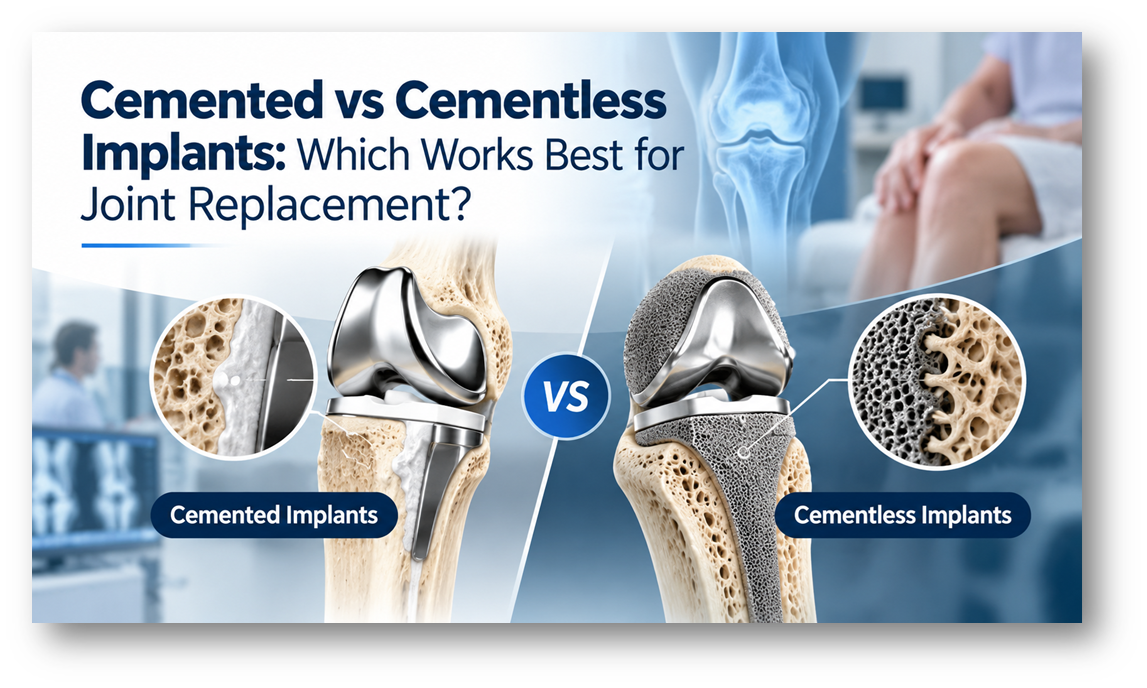
Joint replacement surgery has become an established treatment option for improving mobility and relieving pain caused by conditions such as arthritis, joint wear and tear, or trauma. While implant selection is an important part of surgical planning, another key consideration is how the implant is fixed to the bone.
There is no single fixation approach that is appropriate for every patient. The choice between cemented and cementless fixation can depend on factors such as bone quality, age, activity level, medical history, the joint being replaced, and the design of the implant. A preoperative clinical assessment helps the treating surgeon determine which fixation approach is appropriate for the individual patient.
What Are Cemented Implants?
Cemented implants are fixed to bone using polymethyl methacrylate (PMMA), commonly referred to as bone cement. The cement is not an adhesive in the conventional sense; it fills the space between the implant and prepared bone and provides immediate mechanical fixation.
Benefits of Cemented Implants
-
Provides immediate mechanical fixation of the implant.
-
Can be useful when bone quality makes biological fixation less predictable.
-
Has a long history of clinical use in joint replacement surgery.
-
Can help provide early implant stability following surgery.
What Are Cementless Implants?
Cementless implants are designed to achieve fixation without bone cement. Their surfaces may be textured or porous to support biological fixation, allowing bone to grow onto or into the implant surface as healing progresses
Benefits of Cementless Implants
-
Relies on biological fixation as bone integrates with the implant surface.
-
Can be appropriate for patients with sufficient bone quality to support biological fixation.
-
Avoids the use of bone cement for the fixation of the relevant component.
-
May be considered when the surgeon expects reliable bone ingrowth based on the patient's anatomy and implant design.
Cemented vs Cementless Implants
| Factor |
Cemented |
Cementless |
| Fixation principle |
Uses PMMA bone cement for mechanical fixation |
Relies on biological fixation through bone growth onto/into the implant surface |
| Initial fixation |
Provides immediate mechanical fixation |
Stability develops as biological fixation progresses |
| Bone quality |
May be considered when bone quality is a concern |
Requires suitable bone quality for reliable biological fixation |
| Patient factors |
Selection depends on the individual clinical situation |
Selection depends on the individual clinical situation |
| Universal choice? |
No |
No |
The table is a general overview rather than a rule for selecting fixation. Modern evidence supports individualized decision-making because outcomes can vary according to the joint, component, implant design, bone quality, patient characteristics, and surgical circumstances.
How to Choose the Right Implant Fixation?
-
Bone quality: Bone density and structural quality are important when assessing whether biological fixation is likely to be reliable.
-
Patient considerations: Age, activity level, body characteristics, medical history, and other clinical factors may influence the fixation strategy.
-
Joint characteristics: The hip and knee have different anatomical and biomechanical considerations, so fixation decisions are not identical for every joint.
-
Implant design: Surface characteristics, geometry, component design, and the specific fixation system can influence the choice.
-
Surgical precision: Accurate preparation, component positioning, alignment, and soft-tissue management remain important to joint replacement outcomes.
For patients and healthcare professionals reviewing available implant options, Sharma Orthopedic provides a range of total knee replacement implants and total hip replacement implants for different joint replacement applications.
Cemented vs Cementless Fixation in Hip and Knee Replacement
The choice of fixation can differ between hip and knee replacement. In total knee arthroplasty, both cemented and cementless fixation are established options. AAOS guidance reports similar functional outcomes and rates of complications and reoperations in several comparisons, while also noting that patient-specific circumstances can influence the decision.
In total hip arthroplasty, fixation decisions can also depend on age, bone quality, fracture risk, implant design, and the specific clinical situation. AAOS guidance notes that cemented femoral stems may be considered in older adults at risk of fracture, while the choice between cemented and cementless fixation should be individualized.
What Does Clinical Evidence Say?
Current evidence does not support a universal “winner” between cemented and cementless fixation. For total knee arthroplasty, the American Academy of Orthopaedic Surgeons (AAOS) guideline supports the use of cemented or cementless fixation in relevant comparisons because of similar functional outcomes and rates of complications and reoperations. The guideline also notes that factors such as bone quality and the characteristics of a particular fixation system can affect the decision.
For total hip arthroplasty, AAOS guidance states that cemented femoral stems can be considered in older adults at risk of fracture and emphasizes individualized selection. These recommendations illustrate why fixation should be assessed in the context of the patient, joint, component, bone quality, and surgical plan.
Conclusion
The choice between cemented and cementless fixation is not simply a matter of deciding which method is universally better. The appropriate approach depends on the individual patient, bone condition, joint being replaced, implant design, activity level, medical factors, and surgical considerations.
Both fixation strategies have established roles in joint replacement. The goal is to select an appropriate implant and fixation method for the clinical situation and to use accurate surgical technique and appropriate postoperative care.
Frequently Asked Questions (FAQs)
1. Is it preferable to have a cemented or cementless implant?
Neither method is universally preferable for every patient. Both cemented and cementless fixation can provide effective joint replacement when appropriately selected. The decision depends on factors such as bone quality, the joint being replaced, implant design, and the patient's individual clinical circumstances.
2. What is the average lifespan of cemented and cementless implants?
Implant longevity varies by patient, joint, implant design, fixation method, activity level, surgical technique, and other factors. Rather than applying a single lifespan figure to every implant, patients should discuss expected implant durability with their treating surgeon and consider the evidence for the specific implant system being used.
3. Can cementless implants be used only for younger patients?
No. Although cementless fixation is commonly considered when bone quality is suitable for biological fixation, age alone does not determine whether it is appropriate. Older patients may also receive cementless fixation in selected clinical situations.
4. Why are cemented implants used for knee replacement?
Cemented fixation provides immediate mechanical fixation and has a long-established role in total knee arthroplasty. Cementless fixation is also an established option in appropriate cases, so the fixation method should be selected according to the patient's clinical situation and the implant system.
5. Can bones grow around cemented implants?
Cemented fixation and cementless fixation achieve fixation differently. Cemented implants use PMMA bone cement for mechanical fixation, whereas cementless implants are designed to achieve biological fixation through bone growth onto or into the implant surface.
6. Does implant quality impact joint replacement success?
Implant design and quality are important considerations, but they are only part of the overall picture. Patient selection, fixation choice, component positioning, surgical technique, rehabilitation, and other clinical factors can also influence outcomes.
7. Are there any differences between the recovery period of cemented and cementless implants?
Recovery is individualized and depends on the joint replaced, surgical technique, patient health, and postoperative rehabilitation plan. With cementless fixation, the surgeon may consider the progression of biological fixation when providing postoperative weight-bearing guidance.
8. Which fixation method demonstrates a higher rate of success?
There is no single fixation method that has a higher success rate for every joint and every patient. Evidence supports both cemented and cementless fixation in appropriate clinical situations, and outcomes depend on patient factors, implant selection, fixation, and surgical technique.
9. Is it possible for a cemented implant to become loose?
Yes. Loosening can occur after joint replacement and may be associated with factors such as wear, changes around the implant, infection, or other causes. The risk and timing vary by joint, implant, fixation method, and patient.
10. What is the key aspect of successful joint replacement?
Successful joint replacement involves appropriate patient evaluation, implant and fixation selection, accurate surgery, and appropriate postoperative rehabilitation and follow-up.
References used: