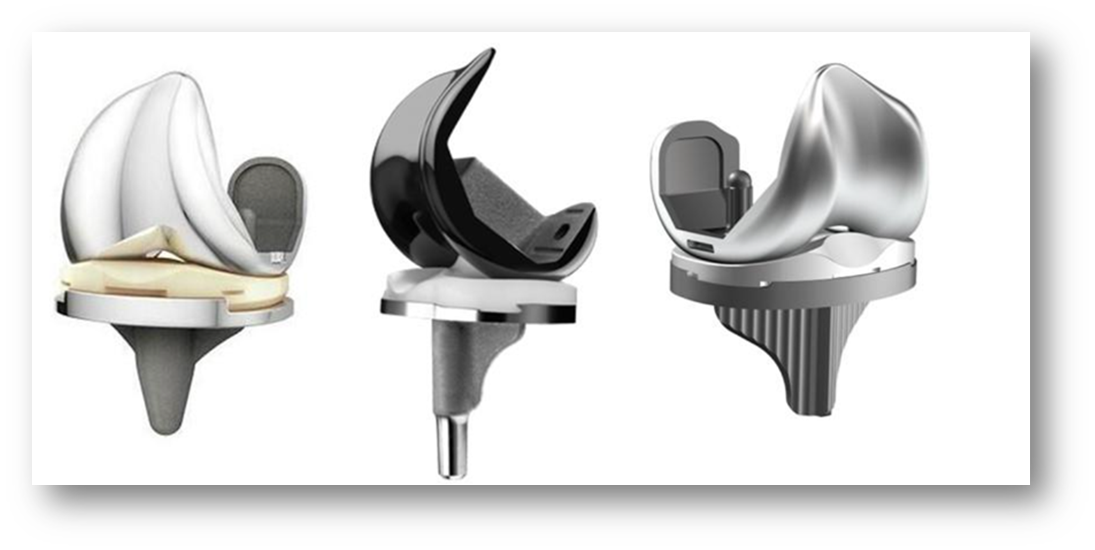
Total Knee Replacement (TKR) is widely regarded as one of the most successful advancements in modern orthopedic surgery. Millions of patients worldwide have benefited from knee replacement procedures that restore mobility, reduce pain, and improve quality of life.
The success of modern knee replacement surgery is largely attributed to the continuous evolution of
orthopedic implants, surgical instruments, biomaterials, and surgical techniques. From simple
hinge-like prostheses developed over a century ago to today's highly engineered implants supported
by robotics and digital technologies,
total knee replacement implants have undergone remarkable
transformation.
Timeline of Total Knee Replacement Implant Evolution
|
Period
|
Major Advancement
|
|
Late 1800s
|
Early hinge-type knee prostheses
|
|
1950s–1960s
|
Introduction of metallic implants and polyethylene components
|
|
1970s
|
Development of condylar knee prostheses
|
|
1980s–1990s
|
Improved fixation methods and implant designs
|
|
2000s
|
Highly cross-linked polyethylene and minimally invasive surgery
|
|
2010s
|
Computer navigation and robotic-assisted knee replacement
|
|
2020s & Beyond
|
Personalized implants, AI integration, and smart implant technologies
|
The Early Days of Knee Replacement Implants
The earliest attempts at knee replacement emerged during the late nineteenth century. These primitive designs aimed to relieve pain and restore limited movement in severely damaged joints. However, the technology available at the time was insufficient to accurately replicate the complex biomechanics of the human knee.
Most early implants functioned as simple hinges and provided limited flexibility. Materials used in implant construction often lacked the durability necessary to withstand continuous stress and repetitive motion.
Major Limitations of Early Knee Implants
-
Limited range of motion
-
Poor replication of natural knee movement
-
High implant wear rates
-
Weak fixation methods
-
Increased risk of loosening
-
Frequent revision surgeries
-
Limited infection control measures
Although these early designs had significant shortcomings, they established the foundation for future orthopedic innovations.
The Breakthrough: Condylar Knee Prosthesis
A major milestone occurred during the 1970s with the introduction of condylar knee prostheses.
Unlike hinge-based implants, condylar designs better replicated natural knee anatomy and movement patterns. This advancement significantly improved patient outcomes, stability, and long-term implant survival.
The introduction of improved surgical instrumentation and fixation techniques further enhanced procedural success rates.
This era marked the transition from basic joint replacement concepts to modern total knee arthroplasty.
Advanced Materials That Transformed Knee Replacement
Material science has played a critical role in improving implant performance and longevity.
Modern total knee replacement implants commonly utilize:
Titanium Alloys
-
Lightweight
-
Biocompatible
-
Excellent corrosion resistance
Cobalt-Chromium Alloys
-
High strength
-
Superior wear resistance
-
Long-term durability
Highly Cross-Linked Polyethylene
-
Reduced wear generation
-
Improved implant lifespan
-
Better articulation performance
Ceramic-Coated Components
-
Lower friction
-
Enhanced biocompatibility
-
Improved resistance to wear
These advanced biomaterials have significantly increased implant longevity, with many modern implants demonstrating survival rates beyond 15–20 years when supported by proper rehabilitation and patient care.
Evolution of Implant Designs
Over the years, implant manufacturers have developed multiple implant configurations to accommodate varying patient anatomies and clinical requirements.
Fixed-Bearing Implants
These implants feature a polyethylene insert fixed firmly to the tibial component and remain among the most commonly used designs worldwide.
Mobile-Bearing Implants
Mobile-bearing designs allow limited movement of the polyethylene insert, potentially reducing wear and improving joint mechanics.
Cruciate-Retaining Implants
These implants preserve the patient's posterior cruciate ligament (PCL), helping maintain natural knee function.
Posterior-Stabilized Implants
These designs compensate for removed ligaments through specialized implant geometry that provides enhanced stability.
The availability of multiple implant designs allows orthopedic surgeons to tailor treatment according to individual patient needs.
Modern Technologies Revolutionizing Knee Replacement Surgery
Advancements in surgical technologies have transformed both implant placement accuracy and patient outcomes.
Computer-Assisted Navigation
Computer navigation systems provide real-time guidance during surgery, helping surgeons achieve:
-
Improved implant positioning
-
Better alignment accuracy
-
Enhanced surgical precision
Robotic-Assisted Knee Replacement
Robotic platforms have become increasingly popular in orthopedic surgery. Give below are some of the key-benefits of robotic-assisted knee replacement procedure include:
-
Personalized surgical planning
-
Greater implant placement accuracy
-
Reduced alignment errors
-
Better soft tissue balancing
-
Improved consistency
Robotic-assisted procedures represent one of the most significant technological developments in modern knee replacement surgery.
Patient-Specific Implants and 3D Printing
The emergence of 3D printing technology has opened new possibilities in orthopedic implant manufacturing.
Patient-specific implants are designed using advanced imaging technologies such as CT scans and MRI data. These customized implants are developed to closely match an individual's anatomy.
Potential advantages include:
-
Improved fit
-
Better joint stability
-
Enhanced range of motion
-
Faster rehabilitation
As additive manufacturing technologies continue to mature, personalized orthopedic solutions are expected to become increasingly common.
How Orthopedic Manufacturers Drive Innovation
The advancement of total knee replacement implants is heavily supported by ongoing
research and development initiatives undertaken by most of the
top orthopedic implant manufacturers.
Leading orthopedic manufacturers across the world continuously invest in:
-
Implant design optimization
-
Biomaterial research
-
Precision engineering
-
Surface coating technologies
-
Quality assurance systems
-
Advanced orthopedic surgical instruments
In addition to knee replacement systems, orthopedic manufacturers also produce:
-
Total hip arthroplasty systems
-
Intramedullary nails
-
External fixation systems
-
Cannulated cancellous screws
-
Cranio-maxillofacial implants
-
Mini plate systems
Continuous innovation remains essential for improving patient outcomes and meeting evolving clinical demands.
The Future of Total Knee Replacement Implants
The future of knee replacement technology is expected to focus on personalization, connectivity, and long-term implant performance.
Smart Implants
Researchers are exploring implants equipped with embedded sensors capable of monitoring:
-
Implant performance
-
Joint loading
-
Recovery progress
-
Rehabilitation outcomes
Artificial Intelligence Integration
AI-driven platforms may assist surgeons with:
-
Surgical planning
-
Outcome prediction
-
Personalized treatment pathways
Next-Generation Biomaterials
Future materials may offer:
-
Improved wear resistance
-
Enhanced biocompatibility
-
Reduced inflammatory responses
-
Extended implant longevity
Digital Orthopedics
The integration of digital health technologies could enable real-time postoperative monitoring and data-driven clinical decision-making.
These advancements have the potential to redefine how orthopedic care is delivered in the coming decades.
Frequently Asked Questions (FAQs)
1. How have total knee replacement implants evolved over the years?
Total knee replacement implants have evolved from simple hinge-based designs used in the late nineteenth century to advanced prosthetic systems that closely replicate natural knee movement. Modern implants incorporate improved biomaterials, advanced fixation methods, computer-assisted navigation, and robotic technologies to enhance performance and longevity.
2. What materials are commonly used in modern knee replacement implants?
Most contemporary knee replacement implants are manufactured using titanium alloys, cobalt-chromium alloys, highly cross-linked polyethylene, and ceramic-coated components. These materials offer excellent strength, wear resistance, and biocompatibility.
3. How long do modern knee replacement implants last?
Many modern knee replacement implants can function effectively for 15–20 years or longer. Implant longevity depends on factors such as patient age, activity level, implant design, surgical technique, and adherence to rehabilitation protocols.
4. What is the difference between fixed-bearing and mobile-bearing knee implants?
Fixed-bearing implants have a polyethylene insert that remains securely attached to the tibial component, whereas mobile-bearing implants allow limited movement of the insert. Mobile-bearing designs may offer improved joint mechanics in selected patients.
5. What role does robotic technology play in knee replacement surgery?
Robotic-assisted systems help surgeons plan procedures more accurately and optimize implant positioning. Improved alignment and precision may contribute to better functional outcomes and implant longevity.
6. What are patient-specific knee implants?
Patient-specific implants are customized based on a patient's unique anatomy using advanced imaging technologies such as CT scans or MRI scans. These implants aim to provide improved fit, stability, and joint function.
7. What are smart knee implants?
Smart knee implants are an emerging innovation that may include embedded sensors capable of monitoring implant performance, joint loading, and patient recovery in real time. These technologies are expected to play an important role in the future of orthopedic care.
8. Can knee replacement implants be customized for individual patients?
Yes. Advances in digital planning, 3D printing, and patient-specific instrumentation allow orthopedic surgeons and manufacturers to create more personalized solutions tailored to an individual's anatomy and clinical needs.
9. What are the latest innovations in total knee replacement technology?
Recent innovations include robotic-assisted surgery, highly cross-linked polyethylene, advanced ceramic coatings, patient-specific implants, artificial intelligence-assisted surgical planning, and smart implant technologies.
10. What does the future of knee replacement implants look like?
The future is expected to focus on intelligent implants, advanced biomaterials, digital health integration, artificial intelligence, and personalized orthopedic solutions designed to improve patient outcomes and implant longevity.
Conclusion
The evolution of total knee replacement implants reflects more than a century of orthopedic innovation. From primitive hinge-based prostheses to today's sophisticated implant systems supported by robotics, advanced biomaterials, and personalized surgical approaches, the field has made extraordinary progress.
Modern total knee replacement implants provide improved durability, enhanced mobility, greater patient satisfaction, and longer implant survival than ever before. As technology continues to advance, the future of knee replacement surgery promises even more precise, personalized, and intelligent solutions for patients worldwide.
For orthopedic professionals, healthcare institutions, and implant manufacturers alike, continued innovation remains the key to improving outcomes and advancing patient care.