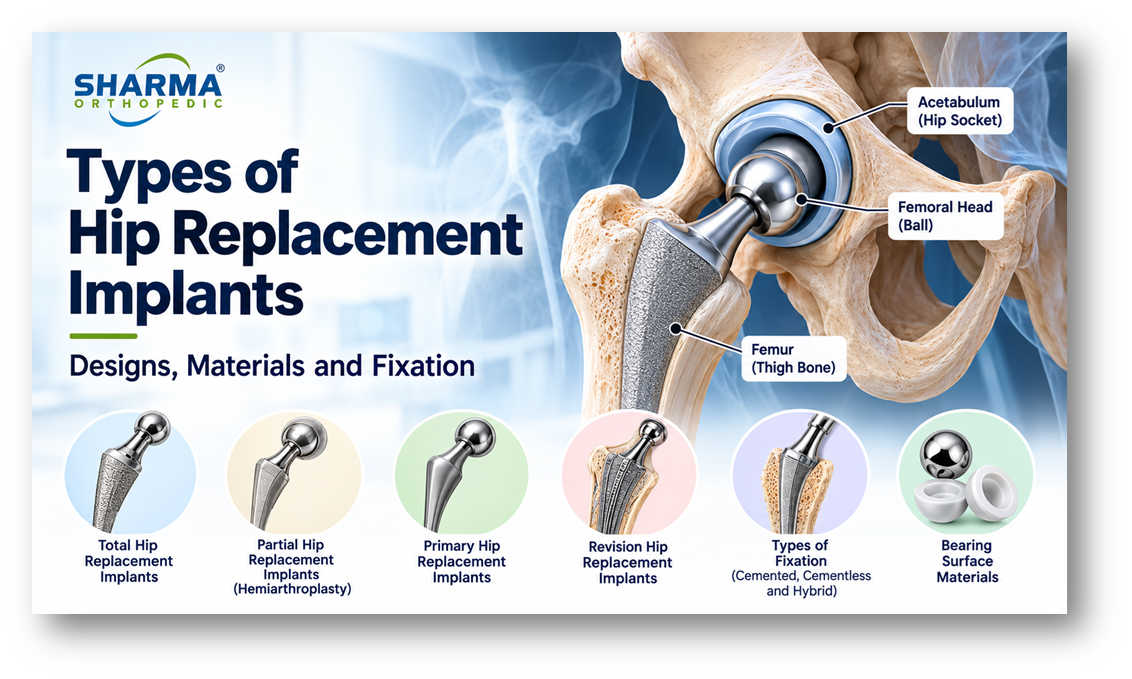
Hip replacement implants play an important role in restoring joint function for patients with severe hip damage caused by conditions such as osteoarthritis, fractures and other degenerative disorders.
These implants, also called hip prostheses, are designed to replace damaged joint surfaces and help restore movement.
However, not all hip replacement implants are the same. They differ in design, the parts replaced, the materials used, the method of fixation and whether the procedure is an initial replacement or a revision surgery.
Understanding the types of hip replacement implants helps healthcare professionals evaluate the available implant systems and their applications. This guide explains the major classifications of hip implants, their components, materials and fixation methods.
What Are Hip Replacement Implants?
Hip replacement implants are artificial components used to replace damaged portions of the hip joint. The natural hip is a ball-and-socket joint, consisting of the femoral head at the top of the thigh bone and the acetabulum, which forms the socket in the pelvis.
During hip replacement surgery, the damaged joint surfaces are replaced with artificial components selected according to the patient's condition, bone quality and surgical requirements.
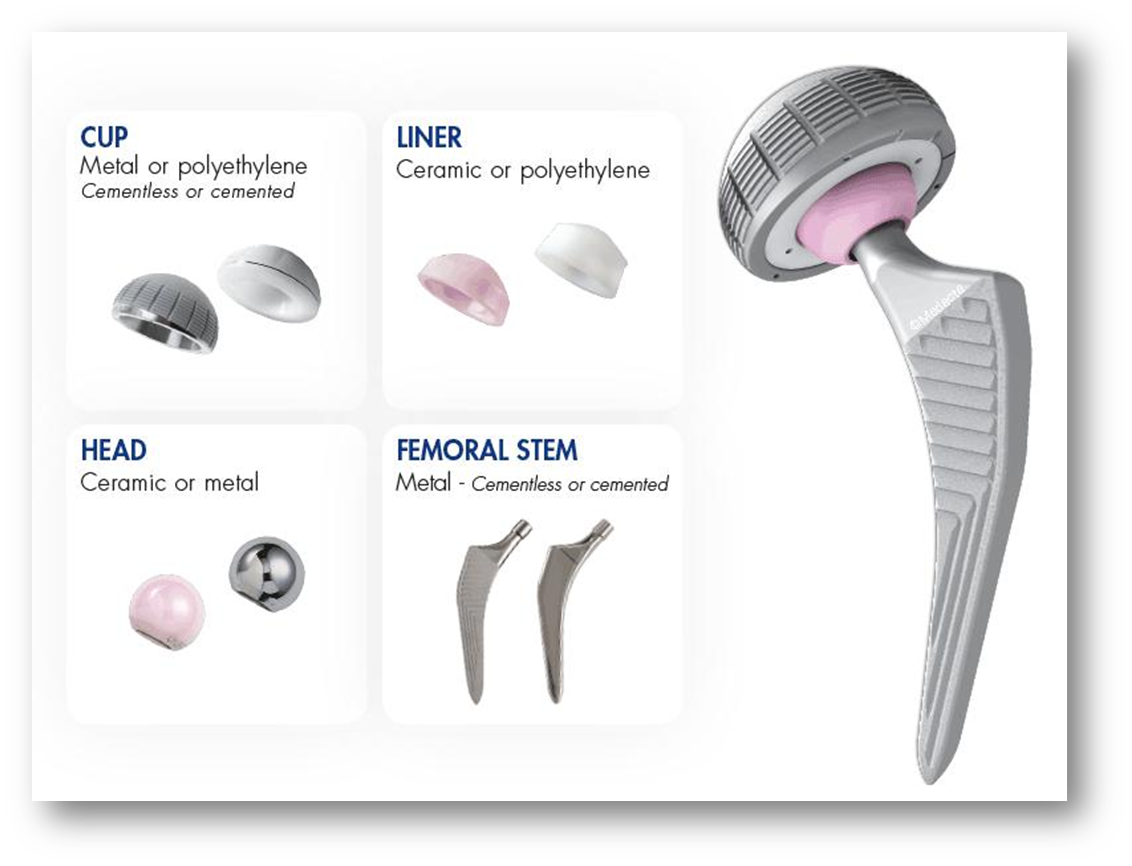
A typical total hip replacement system includes a femoral stem, femoral head, acetabular cup or shell, and a bearing liner. The exact configuration varies according to the implant design.
What Are the Main Types of Hip Replacement Implants?
Hip replacement implants can be classified according to the amount of the joint replaced, the purpose of the procedure, the fixation method and the materials used for the bearing surfaces.
Total Hip Replacement Implants
Total hip replacement implants are used when both the femoral head and the acetabular joint surface need to be replaced. The procedure generally involves placing a femoral component inside the thigh bone and an acetabular component in the pelvic socket.
These systems are commonly used in total hip arthroplasty. They consist of multiple components that work together to provide joint articulation and stability.
Total hip replacement implants are available in different stem designs, cup configurations, bearing combinations and fixation options. The appropriate system depends on the clinical requirements and the surgeon's assessment.
Partial Hip Replacement Implants
Partial hip replacement, also known as hemiarthroplasty, involves replacing the femoral head while retaining the natural acetabular socket.
These implants are commonly considered for selected hip fractures, particularly in older adults, when the clinical circumstances support this approach.
Unlike total hip replacement systems, partial hip replacement implants do not replace both sides of the joint.
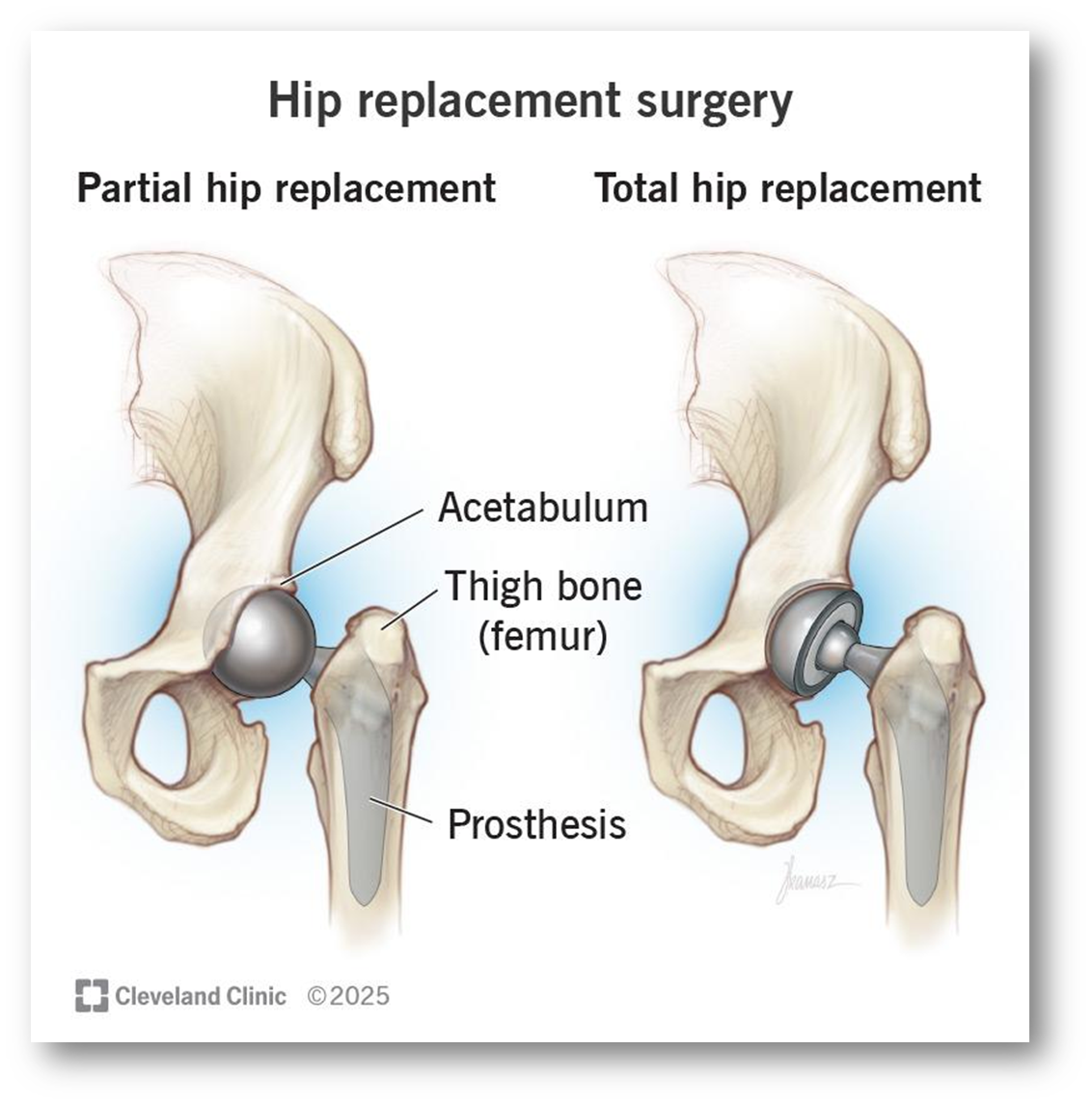
The choice between partial and total replacement depends on factors such as the type of fracture, the condition of the joint, the patient's health and expected functional requirements.
Primary Hip Replacement Implants
Primary hip replacement implants are used during a patient's first hip replacement procedure
These systems are designed to replace the affected joint surfaces and establish fixation in the available bone. Depending on the design, they may include standard or specialised femoral stems, acetabular components and different bearing combinations.
Primary implants are selected according to the patient's anatomy, bone quality, the underlying condition and the planned surgical technique.
Revision Hip Replacement Implants
Revision hip replacement implants are used when an existing hip prosthesis requires partial or complete replacement.
Revision surgery may be necessary because of implant loosening, wear, infection, instability, periprosthetic fracture or other complications.
Revision procedures can be more complex than primary surgery because the surgeon may need to address bone loss or damage to surrounding tissues.
Revision implant systems may include specialised femoral stems, acetabular components, augments and other reconstruction options. The components used depend on the extent of bone loss, the condition of the existing implant and the reconstruction required.
Types of Hip Replacement Implants Based on Fixation
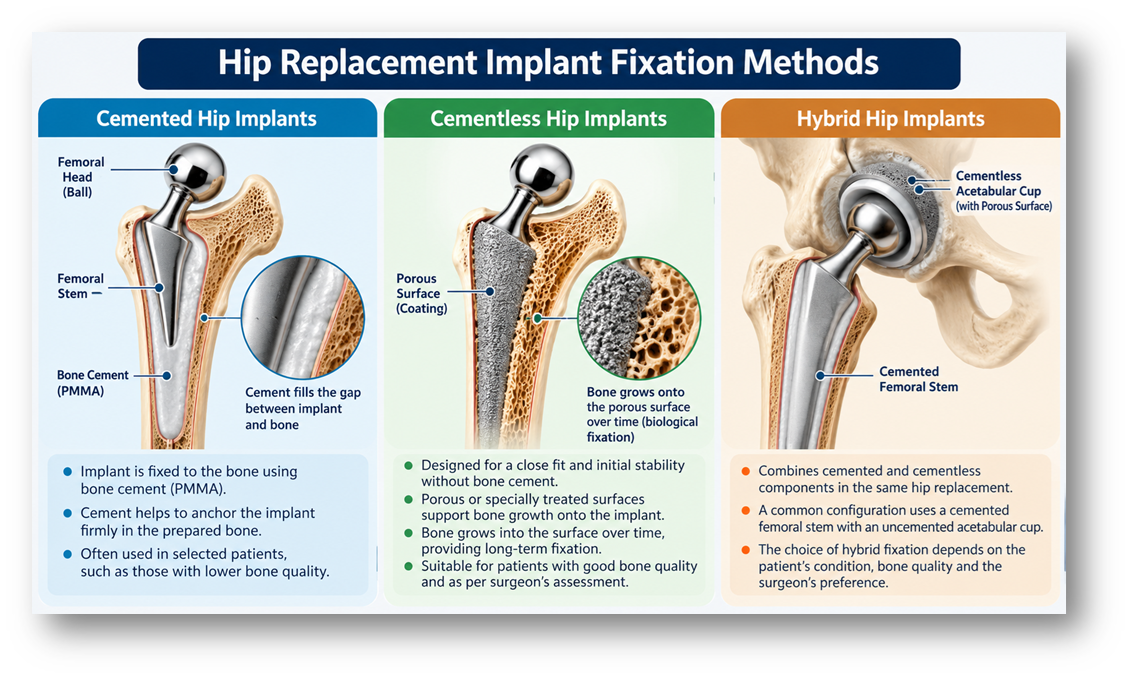
Fixation describes how the implant components are secured to the patient's bone. The principal approaches include cemented, cementless and hybrid fixation.
Cemented Hip Implants
Cemented implants are secured to the bone using bone cement, commonly polymethylmethacrylate (PMMA). The cement helps anchor the implant component within the prepared bone
Cemented fixation may be selected according to bone quality, patient characteristics, the component design and the surgeon's preference and experience.
Cementless Hip Implants
Cementless implants are designed to achieve initial stability through a close fit and, where applicable, porous or specially treated surfaces that support bone growth onto or into the implant.
This process, known as biological fixation, takes time. Cementless designs are available for both femoral and acetabular components, and their suitability depends on factors including bone quality and implant design.
Hybrid Hip Replacement Implants
Hybrid fixation combines cemented and cementless components in the same hip replacement system. A common configuration uses a cemented femoral stem with an uncemented acetabular component.
The choice of fixation is individualised. No single fixation method is appropriate for every patient or every clinical situation.
Types of Hip Implant Materials and Bearing Surfaces
Hip replacement implants use different materials for structural components and for the surfaces that move against one another.
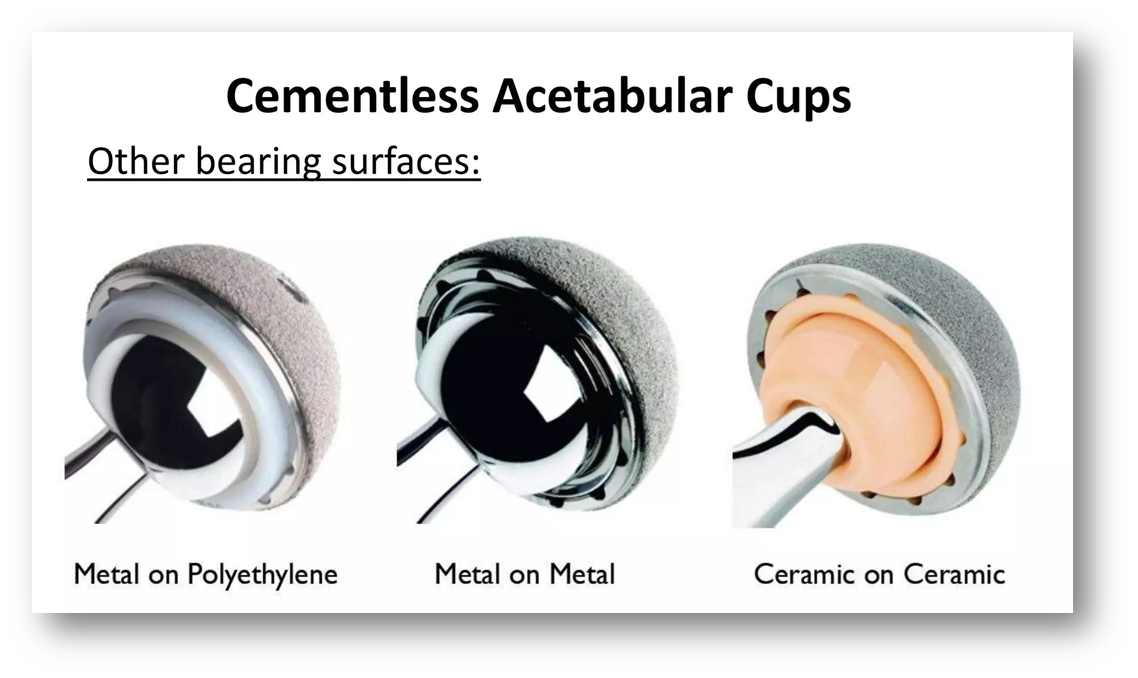
Metal-on-Polyethylene
This combination uses a metal femoral head that articulates against a polyethylene liner in the acetabular component. It is an established bearing option in hip replacement systems.
Ceramic-on-Polyethylene
This combination uses a ceramic femoral head against a polyethylene liner. It offers an alternative bearing configuration, with material selection based on the implant system and clinical requirements.
Ceramic-on-Ceramic
Ceramic-on-ceramic bearings use ceramic materials for both articulating surfaces. Their properties differ from metal-on-polyethylene and ceramic-on-polyethylene combinations, and their suitability depends on the individual case and implant design.
Metal-on-Metal
Metal-on-metal bearings use metal for both articulating surfaces. This configuration has been associated with specific risks, including metal wear debris and elevated metal-ion levels. Its use requires careful consideration of current clinical guidance and device-specific risks.
The material names alone do not determine implant quality or expected longevity. Design, manufacturing quality, positioning, fixation, patient factors and clinical follow-up all matter.
Main Components of a Hip Replacement Implant
Understanding the main components helps explain how different hip implant systems function.
-
Femoral stem: The component inserted into the femur to support the artificial femoral head.
-
Femoral head: The ball component that articulates with the acetabular liner or socket.
-
Acetabular cup or shell: The component positioned in the pelvic socket.
-
Acetabular liner: The bearing surface fitted within the cup or shell in many modular systems.
Not every implant system uses the same configuration. Component sizes, shapes, surface treatments and material combinations vary across designs.
How Is the Appropriate Hip Replacement Implant Selected?
There is no single hip replacement implant that is best for every patient. Implant selection depends on several factors, including:
-
The underlying condition and extent of joint damage
-
The patient's age, activity level and overall health
-
Bone quality and anatomical requirements
-
Whether the procedure is primary or revision surgery
-
The required fixation method and bearing combination
-
The implant system's design, available sizes and clinical evidence
-
The surgeon's experience and the planned surgical technique
The treating orthopaedic surgeon evaluates these factors to determine the most appropriate implant configuration for the individual patient.
Explore Hip Replacement Implant Systems
Understanding the types of hip replacement implants is important when evaluating the available options for joint reconstruction. Total, partial, primary and revision systems serve different purposes, while fixation methods and bearing materials provide additional design choices.
Sharma Orthopedic manufactures orthopaedic implants and instruments, including products for hip replacement procedures.
Healthcare professionals seeking information about available product categories can explore the company's Total Hip Replacement Implants page.
For product-specific information, implant compatibility and technical requirements, consult the relevant product documentation and qualified orthopaedic professionals.
Frequently Asked Questions (FAQs)
1. What are the main types of hip replacement implants?
The main classifications include total hip replacement, partial hip replacement, primary hip replacement and revision hip replacement implants. Implants can also be classified by fixation method and bearing material.
2. What is the difference between total and partial hip replacement implants?
Total hip replacement generally replaces both the femoral head and the acetabular joint surface. Partial hip replacement replaces the femoral head while retaining the natural acetabular socket.
3. What is the difference between primary and revision hip implants?
Primary implants are used during the first hip replacement procedure. Revision implants are used when an existing prosthesis needs partial or complete replacement, often requiring specialised reconstruction components.
4. is the difference between cemented and cementless hip implants?
Cemented implants are secured using bone cement. Cementless implants rely on initial mechanical stability and, where designed for it, subsequent bone growth onto or into the implant surface.
5. Which materials are used in hip replacement implants?
Common materials include metals, ceramics and medical-grade polyethylene. These materials may be combined in different bearing configurations, depending on the implant design.
6. Which type of hip replacement implant is best?
There is no universally best implant type. Selection depends on the patient's clinical condition, bone quality, anatomy, activity level, the procedure being performed and the surgeon's assessment.
7. How long do hip replacement implants last?
Implant longevity varies according to the implant design, materials, surgical technique, patient characteristics and activity levels. No fixed lifespan can be guaranteed for every implant or patient.
Conclusion
The different types of hip replacement implants offer a range of designs for total and partial joint replacement, primary procedures and revision surgery.
Fixation methods, bearing surfaces and component configurations provide further options to meet specific clinical requirements.
A clear understanding of these classifications supports informed discussions between healthcare professionals about implant design and application.
The final choice should always be based on individual clinical assessment, appropriate product documentation and the treating surgeon's judgement.